

Information and buying guide
The hockey sticks we use can greatly influence our game. There is no better or worse hockey stick, the best stick is determined by your personal preferences and qualities and is different for every hockey player. Hockey sticks can differ in many ways and, therefore, we want to help you find the best option for you, so you can enjoy playing.
How to find your correct size?
Using the correct size of a stick is important for your posture during the game. This can influence your technique and is very important to avoid adopting bad habits. The length of a stick varies between 18″ and 41″ (the double quotes ” represent an inch, one inch is equal to 2.54 cm). Where 18″ is a mini stick that is perfect as a gift or souvenir for newborns or children under 2 years old, or as a souvenir and 41″ is an extraordinarily long stick used by goalkeepers during “shoot-outs”. The sizes we offer are 24″ – 35″ for junior hockey sticks and 36.5″, 37.5″ and 38.5″ for senior hockey sticks. We also offer an 18″ stick in the Accessories department and 41” sticks in the Goalkeepers.
Determining the correct stick length can be difficult, especially for children. To do this, we are going to explain it in a very easy way. There are some methods to choose the size, but they all end up at the same point. We will use the Belly Button Method because it is the easiest to understand and the most widespread. Key points regarding size:
Junior sizes: Sticks from 18” to 35.5” not all brands make all sizes, the most common are (18”-24”-26”-28”-30”-32”-33”-34”-35”).
Adult sizes: When size 35” becomes too small we move to adult size, which we will no longer look at size by height, but it will be size 36.5” for the vast majority of players and some 37.5” and 38.5” (we explain why later).
The Belly Button Method
This method is a well-known and reliable way to estimate the length of the stick you need. You must take the measurements with shoes on. (If you cannot, add 2 cm to the final length).
Stand up straight. Locate your belly button. Table measurements:
Option 1: Measure the distance between the floor and your belly button (preferably with sneakers on, otherwise add 2 centimeters).
Option 2: Look for the height in column 1 of the table, it is another option, not so exact. Find the correct length, height (column 1) or belly button distance (column 2) in the table. Choose your favorite stick according to the measurements in the table below. If your size is between 2 measurements, choose the larger one.
| Minimum adult or child height (cm / ft) | Floor–belly button distance (cm / ft) | Select sticks in your size |
|---|---|---|
| Less than 105 cm / down to 3’44″ | < 61 cm / < 2′ | View 24″ Sticks |
| 105 to 110 cm / 3’44” to 3’60” | 61 – 68.5 cm / 2′ – 2’24” | View 26″ Sticks |
| 110 to 115 cm / 3’60” to 3’77” | 68.5 – 74 cm / 2’24” – 2’42” | View 28″ Sticks |
| 115 to 120 cm / 3’77” to 3’93” | 74 – 79 cm / 2’42” – 2’59” | View 30″ Sticks |
| 120 to 132.5 cm / 3’93” to 4’34” | 79 – 81.5 cm / 2’59” – 2’67” | View 32″ Sticks |
| 132.5 to 140 cm / 4’34” to 4’59” | 81.5 – 84 cm / 2’67” – 2’75” | View 33″ Sticks |
| 140 to 150 cm / 4’59” to 4’92” | 84 – 86.5 cm / 2’75” – 2’83” | View 34″ Sticks |
| 150 to 160 cm / 4’92” to 5’24” | 86.5 – 89 cm / 2’83” – 2’91” | View 35″ Sticks |
| More than 160 cm / up to 5’24” | > 89 cm / > 2’91” | View 36.5″ Sticks |
| More than 175 cm / up to 5’74” | — | View 37.5″ Sticks |
| More than 185 cm / up to 6’06” | — | View 38.5″ Sticks |
Scroll the table from left to right to see all columns.
What composition is best?
The composition of the hockey stick is important for its stiffness, power and feel in the game. Before, hockey sticks were only made of wood, today, we still have wooden sticks, but most sticks are made of Composite. By Composite we mean sticks that are composed of Carbon, Fiberglass, Aramid, Kevlar and resins.
Carbon in hockey sticks represents stiffness, power, durability and resistance. The more carbon, the stiffer the hockey stick will be. A stiff stick means less flexibility and feel with the ball. Less flexibility means that there is not much flex in the stick when you hit the ball, this gives the ball more speed when you play. This is one of the reasons why almost all the best players choose sticks with 90-100% carbon. Less feel makes it a little harder to control the ball but for experienced players this is not a problem. Carbon is a very strong but light fiber. That is why the strength and durability of these sticks are very high, but the sticks are still light. A high percentage of carbon in the stick is the perfect choice for advanced players.
Fiberglass sticks are flexible, affordable and light. The flexibility of the hockey stick gives less power, but being softer it gives more feel and, therefore, it is easier to control the ball and learn new techniques. The feel of the fiberglass stick is greater than with Carbon sticks. It does not have as much power as Carbon sticks, but this is not necessary in most situations. Fiberglass is also a very light material and this fiber allows for more affordable prices.
From here any stick that is between the two extremes, 100% fiberglass or carbon, will have characteristics according to the value of its composition. Example: a stick 20% Carbon, has 80% fiberglass, so we will have a stick a little stiffer and more resistant than a 100% fiberglass stick.
It is important, from our point of view, that the player evolves with the stick, that is, that as the player gains strength, they gradually choose more carbon in their stick, and not pick a 100% carbon stick at age 11 because they will not take advantage of its performance.
The wooden hockey sticks are the most traditional sticks. The feel you have with wooden sticks is even greater than with composite sticks, that is why there are still indoor hockey sticks that are still being made of high-quality treated wood. Because in indoor hockey hitting is not allowed, and control (the feel of the stick when we have the ball) is essential.
In the market we find wooden sticks as the entry-level price for adults and children, and in indoor hockey sticks we find entry-level and higher-priced sticks.

What should be the position of the curve (bow) of your hockey stick?

The curve position is related to the place where the bow is optimal. This is measured in millimeters. These millimeters are the distance between the lowest point of the blade and the point of maximum curvature of the stick.
The closer the bow is to the ground, the lower the position value will be. At Flick Hockey we decided to divide the sticks into three types of curve positions: mid bow or Mid Bow, low bow or Low Bow and super low bow or Super Low Bow. We decided to do it this way because every brand gives it a name and even we had problems understanding it.
Just like with all aspects, the position of the bow also depends on your preferences:
- Mid Bow: Traditional player, classic hit, flat push.
- Low Bow: 3D dribbling, aerial passes.
- Super Bow: 3D dribbling++, drags and flicks.
What curve depth best suits your preferences?

The bow of the stick is the degree of curvature relative to a flat surface. If you place the stick on the ground, with the flat side down, the distance between the stick and the ground represents the curvature of the stick. The preferred degree of curvature depends on the person. We divide the degree of curvature into three groups, look at the table, although the most common are 24mm or 20mm sticks.
What weight should you choose?

The weight of the stick is given in grams. With a very light stick you can move quickly and play easily, but you lose some power in the shot if you do not have a good shooting technique. With a heavier stick you can shoot harder but moving it quickly can be more difficult. Depending on your playing style and preferences, the choice of weight may differ. We divide the weight into three categories, look at the image.
Sticks with more carbon, due to their stiffness, give us power even if the weight is light, you can see that at the end of the size it says SL, L for example. This means superlight (SL) and light (L).
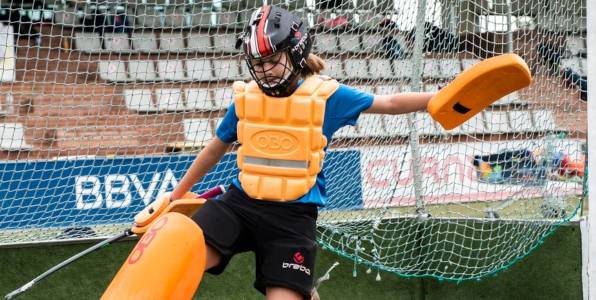
Which goalkeeper stick to choose?
When it comes to choosing a stick for a goalkeeper, it is important that we choose a stick with which we feel comfortable, as a goalkeeper we have different demands and tastes compared to the rest of the players on the field. Every goalkeeper is different and, we may prefer different weights and lengths. With the longest sticks we will achieve a greater reach, in addition to being very useful in the penalty shootout.
There are two types of sticks that we goalkeepers can use. One is the field player stick (highly recommended and is the one most of us use) since the weight, strength and balance allow us to block shots and also pass the ball.
The typical goalkeeper stick we know and that, only we can use, has very good advantages, since the blade is more curved and has a larger stopping surface. It is used, especially in the shootout.
Sometimes, we come across goalkeeper sticks that are too light, which gives us the feeling that it is not strong, firm and that affects the time of making the saves.
When choosing a stick, we must try different types to see which one best suits our needs. For example, we come across defender sticks, these have the flatter horizontal surface, which is good for stopping shots and for aggressive styles. The defender stick is a very good option, since another type of player stick (mid or forward) already has more curve and is specific for other movements.
There are many goalkeeper sticks on the market that we can use, but it is very important that you find the one that best suits you and your needs.